Kriya Yoga Insights: Living Superconsciously Every Day

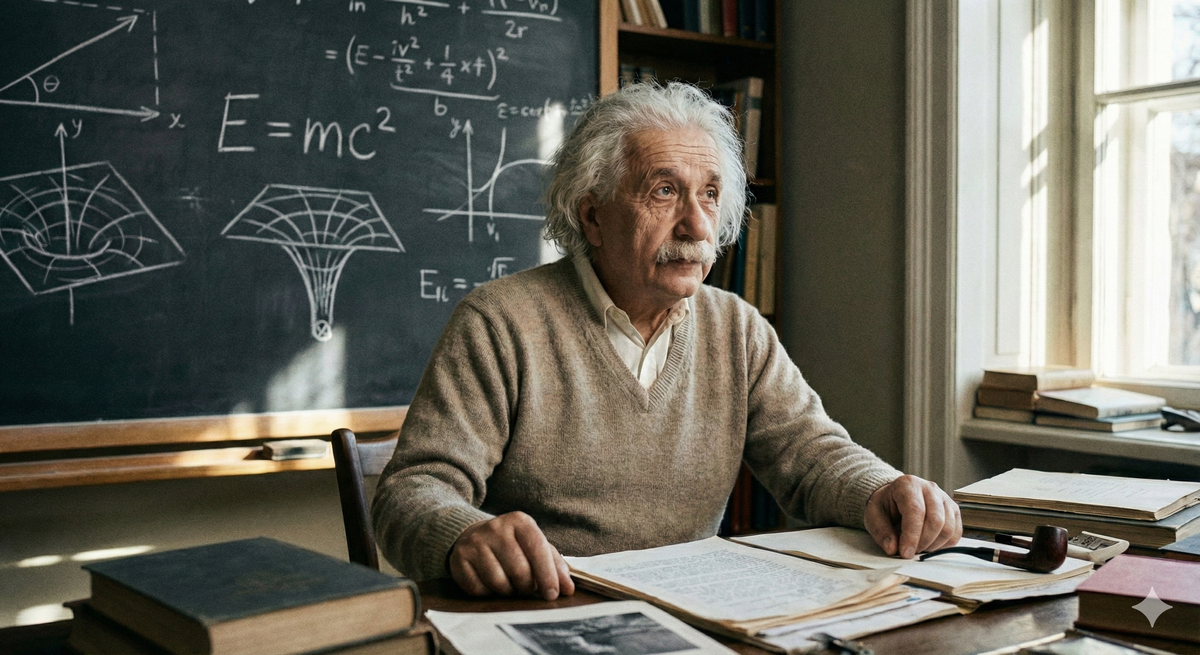
In his groundbreaking general theory of relativity, Albert Einstein describes gravity as the curvature of spacetime (a fusion of three spatial dimensions and one temporal dimension) caused by mass and energy. Everything in the universe, including light, he posited, travels through spacetime. Massive objects can warp spacetime through their gravitational fields. If that happens, light travelling through the warped spacetime would appear bent. As far as other scientists were concerned, this was merely a theory cooked in Einstein’s mind. Furthermore, there was no way to test this idea in the lab. One of the only ways to test this would be to observe the bending of starlight as it passed near the Sun (that is, a massive object) during a total solar eclipse.
Four years later, when his theory was proven by the solar eclipse on May 29, 1919, Einstein rose to stardom unlike any theoretical physicist since Newton.
When the news reached him via telephone, Einstein’s reaction was rather stoic – “I knew my theory was right,” he quietly remarked. One of his students, observing his reaction (or rather, a lack of it), couldn’t help but ask – “But what would you have done if your theory was proven wrong?” He replied nonchalantly, “Then I would have been sorry for the dear Lord; the theory is correct.”
While it’s easy to dismiss his response as arrogance, I believe it came from a deep intuitive understanding of how the universe works. Throughout his life, Einstein often relied not on data but on thought experiments and flashes of intuition. When developing his Special Theory of Relativity, for instance, he would ask questions like, “What would it feel like to run alongside a beam of light?” or “How would someone inside a f alling elevator experience gravity?” Many of these insights initially contradicted the accepted Newtonian view of physics—but over time, they were proven to be true.
How did he discover these novel insights? Where did his ideas come from? Where do all ideas and inspirations come from? The yogis tell us that these ideas come from a state of awareness called the Superconscious.
We alternate between three states of consciousness: the conscious, subconscious, and the superconscious. The conscious mind supports analysis, logical thinking, and reasoning, while the subconscious mind serves as a storehouse of past memories and habit patterns.
All three states of mind play important roles in our daily lives. The superconscious mind, however, stands apart—it’s the only one without drawbacks. The conscious mind helps us think rationally and make decisions, but it’s easily swayed by others’ opinions and often overwhelmed by the vast amount of information we face today. The subconscious mind, on the other hand, supports us by automating actions through habits, yet it can also trap us in unhelpful patterns that limit our growth and potential.
The superconscious is a state of clear, calm awareness that perceives life as a unified whole rather than as separate parts. It is the awareness of one’s true self—rooted in perfect love, ineffable joy, and serene, expansive wisdom. The psychologist F. W. H. Myers described the superconscious as “the treasure-house, the region that alone can explain the great, unselfish, heroic deeds of men.”
In today’s fast-moving world, people are told to think “outside the box.” The box they refer to consists of our conscious and subconscious states of awareness. To go outside this “box” is to break free into the limitless possibilities of the superconscious.
Living Superconsciously

The most effective way to elevate the mind to the superconscious level is through meditation. By practicing techniques of breath and energy control—such as Kriya Yoga—one learns to uplift awareness and rest in that higher state of consciousness. In these moments, the mind becomes perfectly still and perceives truth directly. Inspiration and insight flow naturally and without effort. Even beginners in meditation often find that creative ideas begin to arise during, or soon after, their practice.
While meditation is essential to bring superconsciousness into our daily lives, much more is needed. Swami Kriyananda says, “You will attain superconsciousness more quickly if you seek to attune yourself with it in your daily activities, and not only in meditation. You don’t have to be in superconsciousness to think superconsciously.”
The first thing we must do is approach all problems with full faith and confidence that their solutions already exist. Nature proves this to be true. The antidote to a poisonous plant is usually found close to it. In life, too, the solution to every problem exists, often in the problem itself.
The intellect rarely arrives at the deepest solutions because it tends to think in terms of separation rather than unity. Historians note that one of Einstein’s greatest strengths was his ability to hold two opposing ideas in his mind until a higher harmony revealed itself—a more complete and unified understanding. To discover such truths, one must first have faith that a solution exists.
A few years ago, during a public program, the teacher scheduled to give a talk on meditation didn’t show up. I was asked to take her place at the last minute. I had hardly any time to think about what I would say. Though I had taught a few meditation classes before, I was used to having ample time to prepare—and the comfort of my written notes! With no other option, I gathered my focus, centered my mind, and placed the outcome in God’s hands.
As I began to speak, ideas and insights I had never considered before started to flow into my mind like a waterfall. After the talk, several people came up to tell me how much they had enjoyed it. That experience became one of my first lessons in how faith can open the door to superconscious guidance.
Swami Kriyananda was once speaking with two of his students about the ability to draw divine guidance at will. To demonstrate his point, he said, “I bet I could sit down right now and write a Japanese melody.” He then went to the piano and composed a piece on the spot — the song now known as “Cherry Blossoms in Kyoto”. (I urge you to listen to it, if you haven’t already.)
Geniuses from all walks of life owe their success to superconscious inspiration. The mathematician Srinivasa Ramanujan famously said,
“I owe everything to [Divine Mother] who leaves these mathematical formulae on my tongue in my dreams. An equation for me has no meaning unless it expresses a thought of God.”
Living In the Eternal Now

Another important attitude for drawing superconscious guidance is to live in the Eternal Now, free from the consciousness of time. Let me share again an episode from Swamiji’s life.
During a lecture tour in 1995, Swamiji’s pulse went up to 160 bpm. The doctors soon discovered that one of his heart valves needed urgent replacement lest he die at any moment. After the necessary procedures were done, Swamiji was told to take it easy and get twelve months of complete rest.
As things turned out, Swamiji hardly got a week’s worth of rest that year. He called it one of the busiest and most stressful years of his life (if you know more about Swamiji’s life, that’s saying a lot!). Not only was he committed to several lecture tours and creative projects (writing and music), but he was also going through an excruciating lawsuit with long hours of depositions.
Time Warner, a famous publishing house in America, had previously published several of his books. He was now working on a book for them titled “Meditation for Starters.” Toward the end of April that year, Warner’s editorial staff decided they wanted to change the title of the book to “Superconsciousness.” Swamiji felt that to do justice to this title, he would need to write a whole other book, which would take at least two years. Warner, however, gave him only two months. With other commitments already looming on his head, he barely had a month for the job.
He switched off his phone, accepted no visitors, refused to look at his mail, and told God firmly, “You’ve got to help me! I simply cannot do this job alone.” Praying thus, he plunged himself into the work. A book that needed two years was finished in less than a month.
How did he do it? Swamiji says, “Don’t let considerations of time dissuade you from undertaking any project that seems to you important. Since time is an illusion, it can be more easily understood through calm, clear awareness. Whenever you find yourself ‘driven to the wall’ as it were, by urgent demands, whether by life or by other people, withdraw for an instant into your center within. Then tell yourself, ‘I will not be ruled by time consciousness. I can only be right here, right now. I will live, therefore, in full awareness of the present.’”
It’s important not to let the intellect block the flow of inspiration. Reason will always tell you, “This isn’t possible! I need more time!” But if you firmly put it aside and open your mind like a chalice to receive higher guidance from your superconscious, you will be surprised at how much you can accomplish.
Time and again, I have witnessed this principle at work. When I worry or struggle to find an answer, it never comes. But when I remain calm and centered in the present moment, trusting fully in God’s guidance, the solution always reveals itself. Whether it’s writing an article like this, giving a talk, or facing some other challenge, I’ve found that divine inspiration unfailingly flows—if only I open myself to it with calm faith.
Superconscious living needn’t be hard. In fact, once you learn how to do it, it can be quite fun. Begin by attuning yourself to this higher state in simple, everyday activities, and soon you’ll find yourself naturally living from that awareness. It is in the superconscious state that we discover not only solutions to life’s challenges but also unconditional joy, guidance, and love.