Swami Kriyananda: Friend and Guide

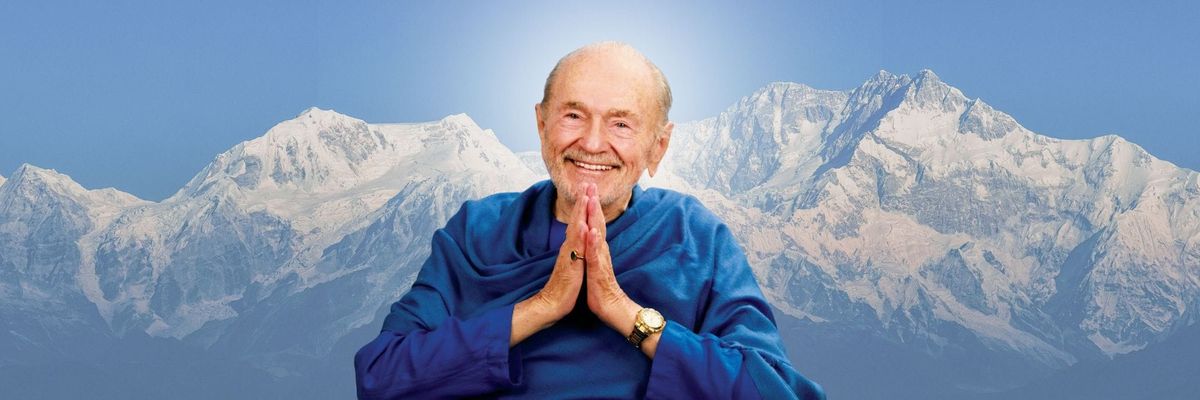
On the centennial of Swami Kriyananda’s birth, I find myself reflecting on his life and legacy. If you are reading this article, I assume you already know that Swami Kriyananda (Swamiji) was a direct disciple of Paramhansa Yogananda (Master). Swamiji founded Ananda Sangha, a global spiritual movement based on the teachings of his Guru, in 1969.
This year has brought a special joy to all those whose lives were touched by Swamiji. As devotees around the world share their memories during his centennial, each story feels especially precious to me, since it was not my karma to meet him in this lifetime. I was therefore surprised when I was asked if I might write something about him as well.
My first response was hesitation. Writing about Swamiji feels rather like shining a torch in the face of the sun. What could I possibly add to the beautiful memories of those who had the blessing of living and serving with him? For some time, I quietly set the idea aside.
Later it occurred to me that if I had nothing to share simply because I had not met him in the body, it would imply that his guidance ended when he left this world in 2013. Yet nothing could be further from the truth.
And so, I humbly offer a few reflections on how Swamiji’s presence has touched my life. If they convey anything at all, I hope it is this: that his guidance, friendship, and living spirit continue to bless those who sincerely seek God.
Towards the end of Swamiji’s life, a student asked him, “Will you be able to help us even when you’re not with us in the body?” He replied, “I hope so.” Much later, the student came to realize that Swamiji’s “hope” was not a question of his ability to help us, but rather our ability to receive guidance. As it says in the Bible, “As many as received him, to them gave he power to become the sons of God.” (John 1:12)
I can say with full confidence that I have felt, and continue to feel, Swamiji’s presence guiding my life. Moreover, I am sure that I am only one among thousands who feel the same.
Called to a Great Work
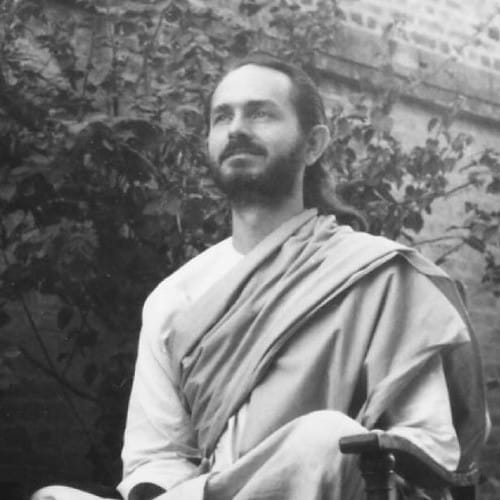
In 1948, after reading Autobiography of a Yogi, Swami Kriyananda took a four-day bus ride across America to meet Paramhansa Yogananda and to become his disciple. Though Swamiji was with Master for only the last three-and-a-half years of his life, the Master entrusted him with numerous responsibilities.
Master would often hint at the nature of Swamiji’s future service by telling him, “You have a great work to do,” or “You must do so and so… because you have a great work to do.” On other occasions, he would be more specific: “Your life will be one of intense activity and meditation,” and “Your work is writing and lecturing.” Swamiji once exclaimed to Master, “Sir, haven’t you yourself done everything already to present the teachings?” The Master replied with a degree of shock, “Don’t say that! Much more is needed.”
Swamiji’s writings have played a crucial role in helping devotees understand the Master’s teachings more deeply, and in learning how to apply them to all aspects of life. He ended up writing more than 150 books. When I came to Ananda, I devoured Swamiji’s writings. Never before had I read deep spiritual truths expressed with such crystal clarity. Very few authors, in my experience, take such loving care to express profound concepts with such simplicity.
Music That Awakens the Heart
Yet, even before his books piqued my interest, it was his music that “had me sold.” I will never forget listening to “Love Is a Magician” for the first time. Tears of spiritual longing flowed unobstructed as my heart opened like never before. It filled me with a deep conviction that seeking God was the only purpose of my life.
Ever since then, I have listened almost exclusively to his music. I grew up learning the tabla (traditional Indian drums) and played across various genres with a variety of musicians. After finishing college, however, I stopped playing any instrument, for I could hardly relate to the popular genres of music out there.
Discovering Swami’s music endowed me with a renewed purpose to start playing music again. After years without touching an instrument, I began playing the tablas with our kirtan group at Ananda in Delhi. Later, I picked up the harmonium and the guitar just so I could sing his chants and songs. His music is a wholly new expression of divine consciousness, unlike anything I have encountered. It has the power to uplift one’s consciousness and open a window of attunement and grace to our line of Gurus.
A Living Channel of Wisdom
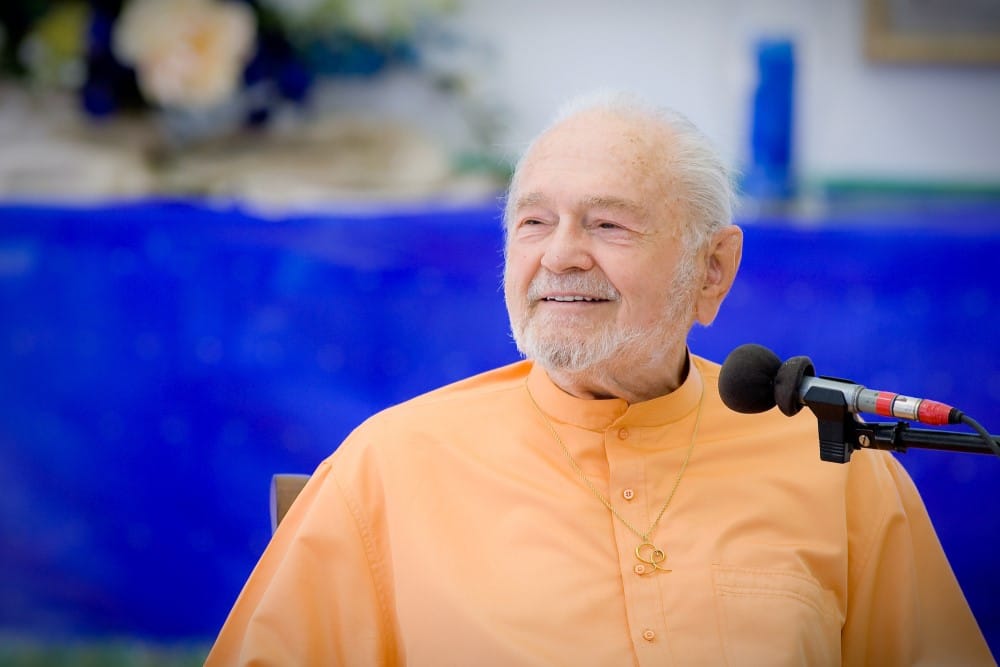
Listening to Swamiji’s talks is another powerful way to tune into his consciousness. The first time I heard him speak, I was amazed by the sharpness of his intellect, combined with the depth of his devotion and his perception of God’s bliss. He would speak on countless topics and branches of knowledge, somehow linking them all to the spiritual path and the topic at hand. By doing so, he met people on their level of understanding and gently guided them toward God.
The only thing he ever wanted to be known as was a “good disciple.” In a world where there’s no dearth of people wanting to be gurus, here was a man who was trying to set an example of an ideal disciple. Indeed, that was the coursing blood of his life. Everything he did was in service to his Guru.
He spent decades trying to attune every thought and feeling to Master until he reached a point where he could sincerely say, “I don’t know where Kriyananda ends, and Yogananda begins.” Mouni Ma, a disciple of Neem Karoli Baba, once commented, “His [Swami Kriyananda’s] discipleship is of the highest order.”
In her book Lightbearer: The Life and Legacy of a Disciple of Paramhansa Yogananda, Asha Nayaswami asks Swamiji near the end of his life, “The first moment I saw you, I thought ‘His consciousness has no boundary—he is limitless.’ You had so much work to do, though, that for a long time you kept a veil over your consciousness. Now your work is done, so you have removed that veil. May I say that, Sir?”
“Yes,” Swamiji said, “because it’s true.”
Swamiji once asked Master, “Will I find God in this life?” Master said, “Yes. But don’t think about it. After many lifetimes, everything has balanced out now. God won’t come to you till the end of life. Death itself will be the final sacrifice you would have to make.”
Clearly, his state of consciousness was far beyond what met the eye. Many of his students have had experiences that have given them a glimpse of Swamiji’s spiritual greatness. Despite that, he would only portray himself as a humble disciple, trying to help those around him. “I can help you much more as a friend,” he said. His humility is as great a miracle as his outward accomplishments.
When asked about his role in our spiritual lives, Swamiji said:
“…[T]ake [from me] that which inspires you in your thoughts of Master. Use this example to help you make Master more real in your lives. Think of him as your focus, and see what you’ve learned from [me] that can help you understand him more. I don’t want you to look to me. But I want you to use me as an inspiration, a channel, a focus, to help you to know better who he is, so that he becomes more real in your life.
“Kriyananda will be a memory. You’ll read about him in books…. But you’ll have people that you know, who make you feel that, ‘Yes, this is alive. If this is what our gurus were like, then this is what I want to be like, too.’ So in your attunement with anyone down the road, let it always be directed back to Yogananda, the last of the line of gurus.”
A New Path of Renunciation

Another significant contribution he made, not only to our spiritual lives but also to those of the masses, is the creation of a new renunciate order. In his book A Renunciate Order for the New Age, he describes a new model based on the positive aspects of renunciation as opposed to the traditional world-negating approach. It is intended for people from all walks of life, married or single, who are committed to finding God, and is open to people of every religious affiliation.
Many sincere devotees seek an outward expression of their inner commitment to God. With this order, Swamiji has given us a way to express our commitment to finding God outwardly and to aspire to greater spiritual heights. Traditional renunciate orders have allowed devotees to lead a single life of chastity, poverty, and obedience to spiritual superiors.
While it’s a holy vocation, not everyone is suited to such a life. It not only leaves out those who are married or seeking a partner or family, but also those who don’t resonate with these traditional ideals. Many of these ideals, including those expressed by the ancient Swami order founded by Shankaracharya, needed to be adapted to this new age of energy, Dwapara Yuga.
With the creation of this order, Swamiji has given hope to devotees from all walks of life. I, and many others who are a part of this order, feel that it will spread, in time, far beyond the boundaries of Ananda to encompass truth-seekers everywhere.
As I said at the beginning of this article, writing about Swamiji’s contribution to furthering God’s light on this planet is a difficult task. Indeed, no heap of books may be enough to accomplish that end. And yet, they will be written, bearing witness for posterity to Swamiji’s love, friendship, and greatness.
In his last Easter letter (2013), Swamiji wrote, “I want only to merge in God. The only lingering thought is that I would like to bring you all with me.”
So friends, as we celebrate the centennial of Swamiji’s birth, let us re-dedicate ourselves to helping fulfill his desireless desire for our freedom in God.