The Law of Reincarnation: The Soul’s Journey of Ascension

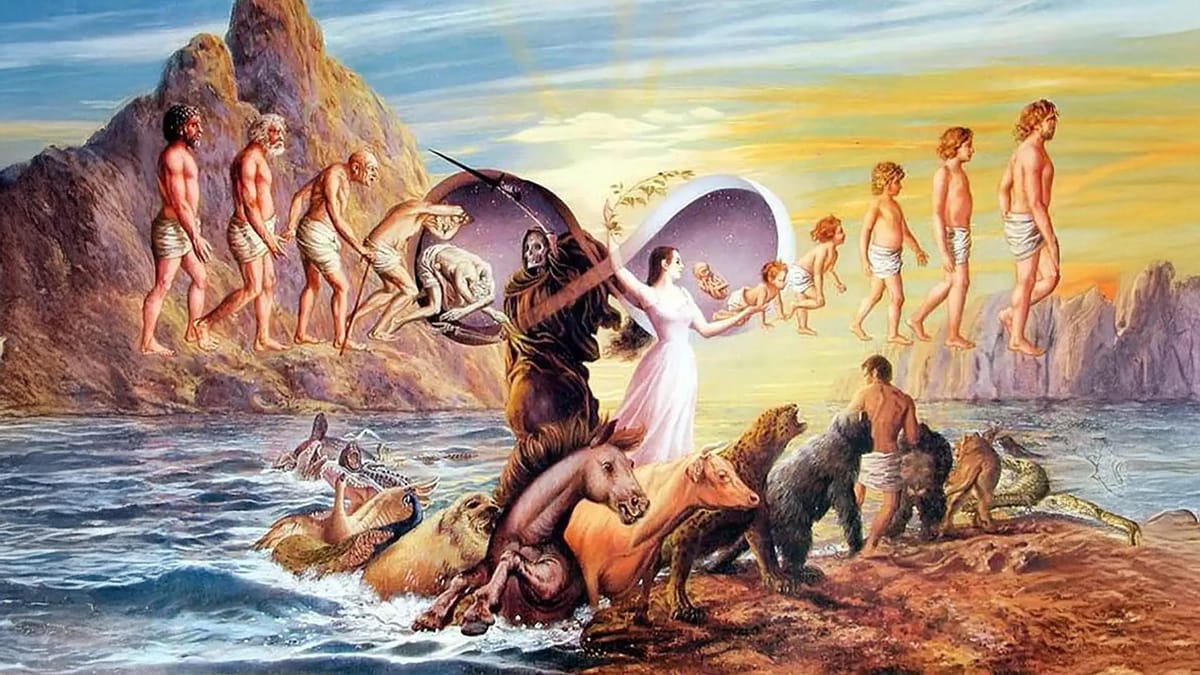
When I was a little boy, a pandit (Hindu priest) told my mother that I was a mongoose in my previous life. I didn’t take it too seriously. But every time I saw a mongoose, I would feel like a puppet in the hands of a Cosmic Dictator, assuming random life-forms at His whims and fancies. Needless to say, the theory of reincarnation was utterly repulsive and inexplicable to me. My doubts were finally resolved when I came to understand the hidden laws governing reincarnation, as explained by my guru, Paramhansa Yogananda.
Most people, like my former self, find their lives unfolding in mysterious and often unfair ways. Why do babies die inside the womb? Why is someone born crippled? Why do some people find it hard to succeed, no matter how hard they work? And why do some succeed without any effort at all? Reincarnation, when understood correctly, can answer these questions.
Though not apparent at first sight, there is a reason for everything in our lives. Arthur Schopenhauer said that reincarnation alone provides us with an explanation about our innate character, talents, and suffering.
The Soul’s Long Journey
The ancient scriptures teach that the soul is on a long journey, taking birth in many bodies to learn all its lessons before merging back into God. In his poem “God, Christ, Guru,” Paramhansa Yogananda likens this journey of spiritual unfoldment to ascending a spiral stairway:
From the depths of slumber as I ascend,
The spiral stairways of wakefulness,
I will whisper,
God, Christ, Guru.
Why is the soul’s journey likened to a spiral stairway of wakefulness? Imagine yourself on a spiral staircase. As you start climbing, you don’t know exactly where you are because there are no noticeable floors. You can only look up or down to assess how near or far you are from the goal. On the spiritual path, too, it’s impossible to define your exact level of progress—all we know is that we have come a long way and are getting closer to our goal of divine union.
Spiritual growth over many lives is not linear and we do not progress from one level to the next. Neither is it a flat circle where we keep learning the same things over and over. Instead, it is a spiral, because the challenges we face from one life to the next are similar to those we have encountered before. Though we may not feel like we’re progressing, we are, in fact, gradually ascending.
Swami Kriyananda said that most people learn one or two major lessons in one incarnation. That thought is fascinating but also slightly frightening, considering the number of lessons we all have to learn. Naturally, those eager to find God would like to “get on with it” and learn as many lessons as possible in one incarnation. How might we do that?
The Practice of Self-Observation
Regular introspection is a great aid in finding what lessons life is trying to teach us. Too often, we run on autopilot and go through life mindlessly. To identify the lessons we need to learn, the first step is to develop the habit of observing ourselves with non-attachment. This practice, Yogananda says, soon becomes a natural way of being. Soon enough, we will start to see recurring patterns that indicate areas of improvement in ourselves.
For instance, one may leave his job owing to disharmony with coworkers, but find the same problem at his new workplace. Instead of blaming others for it, if he introspects a little, he may realize the need to work on his own attitudes.
Relationships as Classrooms
Since most of our lessons come from our relationships with other people, it is essential to see how we can make them more harmonious. While others’ reactions may not be entirely within our control, we can ask, “Am I doing the best I can do?”
Similarly, we can also perfect the relationships that are already harmonious. Yogananda stressed the importance of expressing perfect love in at least one of our human relationships. He said, “God wants us to give friendship and love to all, but we must perfect it in at least one relationship.” Look at the relationships that are already harmonious and ask, “How can I make my love even more selfless and unconditional?”
Bernard’s Lesson
There’s an insightful story from the life of Bernard, one of Yogananda’s disciples at Mt. Washington. Bernard would often get himself into car accidents. Every time it would happen, the Master would tell him, “Bernard, you ought to be more careful.”
“But Master,” Bernard would protest self-righteously, “none of these accidents has been my fault! One car crossed into my lane from behind and hit me. Another hit me when it went through a red light. Twice, my car was actually hit after I had parked it!”
The Master would reply, unimpressed, “You must be more careful.”
After some thought, he acknowledged that he had a careless attitude in other areas of his life. To his surprise, as he worked on changing his attitude, the related car accidents also ceased.
Everything that comes to us is a result of past karma, whether good or bad, but it is rare to be able to discern the exact cause behind our life’s circumstances.

A Personal Revelation
A few years ago, I developed a tendency to feel rejected, alone, and despondent for no apparent reason. It was a mood that would grip me at random times and would be triggered by the most inconsequential things.
I struggled for months to overcome this tendency. One day, I had an astrological palm leaf reading written thousands of years ago by the ancient sage Agastya. Ancient sages like Agastya and Bhrigu wrote about the lives of people who would live millennia after them. My experience and that of countless others prove that their accounts are accurate. That discussion, however, is for another article.
One section of my reading discussed a particular past life. In that life, my parents died when I was young. Soon after their death, my relatives cheated me out of my inheritance. Somehow, making ends meet, I continued to live an uneventful life. The person I married later in life also left me after a few years. Completely alone, left to fend for myself, I caught a fatal disease and died when I was thirty-nine.
At first, I didn’t think there was any meaning to be drawn from this revelation. It seemed like a rather bleak life. It took me a few more months to connect the dots—the moods of despondency and loneliness I was experiencing were subconscious manifestations of the deep-rooted fears from that life. Understanding my mood in that broader context, I was able to release it, for I knew it was only a projection of a distant but traumatic past. It also taught me to face all challenges with calm and understanding, knowing they might be tendencies carried over from a past life I no longer remember.
Kriya Yoga: The Airplane Route to God
Introspection, therefore, can be constructive. Still, it can be challenging to understand the lessons we are meant to learn. And we can’t always rush to a palm leaf reading to resolve our life’s problems! While we should do our best to understand what God is trying to teach us, there is a quicker way to get out of the spiral staircase of reincarnation. And that is through the scientific technique of Kriya Yoga.
Through the practice of Kriya Yoga, we burn the seeds of past karma residing in the astral spine, thereby reducing the influence that past actions have on our consciousness. When practiced regularly, Kriya aligns our actions with the Divine will, thereby creating less harmful karma that leads to suffering. Master writes in Autobiography of a Yogi that
“Half a minute of Kriya equals one year of natural spiritual unfoldment…The life of an advanced Kriya Yogi is influenced, not by the effects of past actions, but solely by directions from the soul. The devotee thus avoids the slow, evolutionary monitors of egoistic actions, good and bad, of common life, cumbrous and snail-like to the eagle hearts.”
Many Kriya Yogis find themselves radically changed even after a few months of practice. A few years down the line, they have a hard time remembering their old selves. That is because their Kriya practice changed them from within. Just like walking on a spiral staircase, these changes are not apparent from one day to the next, until one fine day we look back (or “down,” I guess!) and are pleasantly surprised to see how far we’ve come.
A Prayer for Liberation
Let us then take up our practice of Kriya Yoga in earnest so that our “eagle hearts” find final emancipation from all suffering. Our daily practice and calm introspection, combined with the grace of God, will ultimately free us from the agonizing cycle of birth and death. As Adi Shankaracharya wrote in his poem Bhaja Govindam:
Punarapi jananam punarapi maranam punarapi janani jathare sayanam,
iha samsare bahudusare krpaya’pare pahi murare
Again and again one is born,
And again and again one dies,
And again and again one sleeps in the mother’s womb,
It is indeed hard to cross this boundless ocean of saṁsāra,
O Lord! Redeem me through Thy grace.